On 21 January 2026, the “Critical History Tours” team met in The Hague to participate in a “Test Tour” developed in 2025 by Uncomfortable Oxford (Olivia Durand, Paula Larsson, and Waqas Mirza). The aim was to implement their critical methodology in a different historical context and to explore how it could be adapted to the urban and historical landscape of The Hague.
The development of the tour was based on thorough historical research, one week of on-site exploration, and participation in existing city tours in The Hague. During this period, the Uncomfortable Oxford team established connections with local stakeholders, including tour guides, activists, institutions, and organizations. These stakeholders were invited to join the Test Tour and provide critical feedback on both its content and methodology.
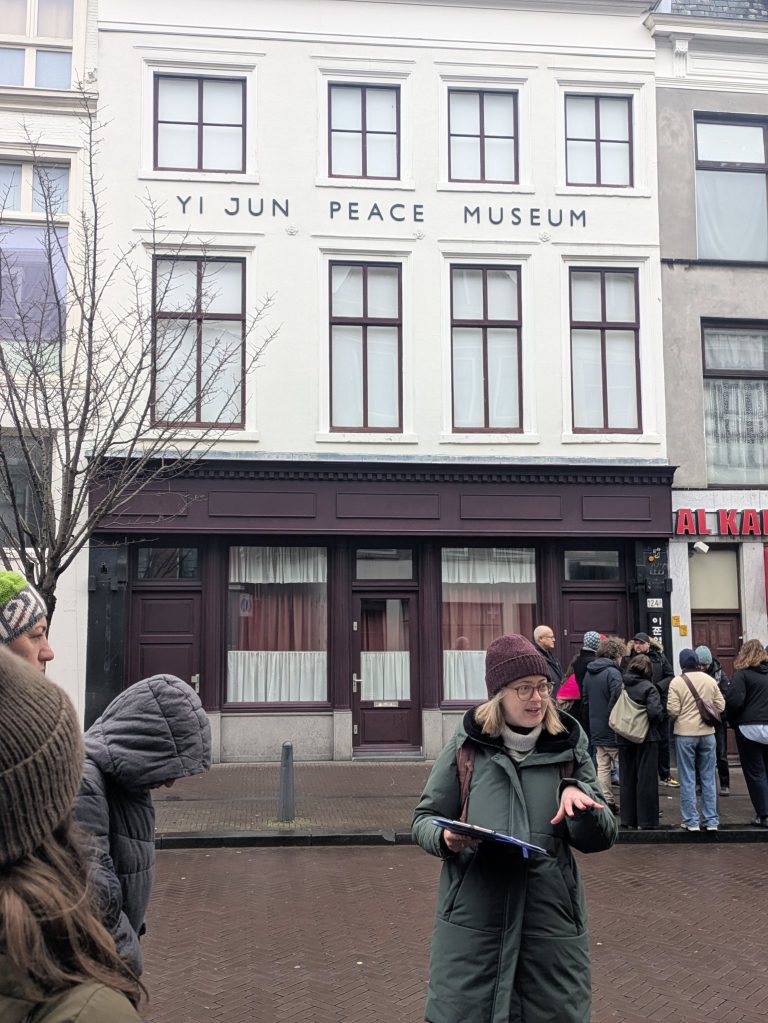
Under the somewhat misleading title “The Peace and Justice Tour” the walk began in front of the Yi Jun Peace Museum—a small museum dedicated to the tragic historical figure Yi Jun, a Korean diplomat and advocate of Korean independence. Yi Jun was part of the Korean delegation that traveled across Eurasia to attend the Second Hague Peace Conference in 1907, where he intended to inform the international community about Korea’s unlawful occupation by Japan. However, he was not allowed to participate in the conference, as Korea was not officially recognized as a sovereign state. He died a few days later under suspicious circumstances. From this first stop, participants were confronted with questions concerning the global “peace and justice” architecture and the underrepresentation of entities—such as national, ethnic, or religious groups—that lack official recognition.


The tour continued with an engaging walk through the city, visiting various landmarks and areas that are not typically included in conventional tourist itineraries. One such site was the mosque in Chinatown, which was transformed in 1981 from an abandoned nineteenth-century synagogue into a place of worship serving the growing Turkish worker population. Another stop was the hypermodern public monument and art installation “Remember Our United Beginning,” dedicated to the history of transatlantic slavery and created only last year. These locations encouraged reflection on migration, memory, and the layered histories embedded in urban spaces.
For many participants, particularly museum enthusiasts, an important stop was the Mauritshuis, the most renowned museum in The Hague, which houses a world-famous collection of seventeenth-century Dutch paintings. Yet the darker side of this institution and its classical-style building lies in its origins in colonial exploitation. The Mauritshuis was built for Johan Maurits of Nassau-Siegen, who served as governor of Dutch Brazil, where plantation slavery generated significant wealth. As is the case with numerous cultural institutions, the history of the Mauritshuis highlights the complex and often troubling relationship between culture, wealth, and violence.
The entire tour lasted approximately two hours, including a short coffee break. This proved sufficient time to visit a dozen locations—buildings, public monuments, and specific urban areas—while addressing challenging topics such as colonialism, international peace and war regulations, the commemoration of violence, women’s emancipation, and hegemonic and marginalized identities. A distinctive feature of the Uncomfortable Oxford methodology is its dialogical approach, which actively involves participants in discussion. The landmarks serve not as endpoints of historical explanation but as catalysts for questions, reflection, and the activation of prior knowledge and personal experience. By avoiding a one-way, didactic, and authoritative narrative, this open-ended approach grants participants agency, encouraging them to share their perspectives and critically engage with the topics presented. In this sense, the tour was critical not only in the themes it addressed, but also in its method, fostering critical thinking and deeper engagement with complex historical issues.
Following the tour, a meeting was held at the EuroClio office with local stakeholders and other participants from The Hague to gather feedback. The general impression was that the tour was innovative and surprising—even for local residents—and that it opened new perspectives on their own city. During the discussion, questions were raised regarding the length of the tour, potential additional landmarks, and the challenges of adapting the format to diverse target groups with varying levels of prior knowledge. The day concluded with a productive exchange on possible avenues for further development and integration of this critical tour into the city’s tourism and educational landscape.
Critical History Tours is a multi-partner European project that uses walking tours to engage with contested histories in public spaces and to support educators and guides in navigating sensitive and polarized pasts.
More about the project HERE